AI Adoption in Banking
Summarise this article with:
AI Agents Are Coming. The Real Question Is Whether Your Organization Is Ready.
European banking has not been slow to experiment with AI. Over the past three years, most major institutions have launched pilots, formed AI task forces, commissioned vendor evaluations, and published internal strategies. The investment has been real. The results have been uneven.
A small number of banks have moved from experimentation to operational deployment — with measurable impact on efficiency, compliance workload, and client service. The majority are still cycling through pilots that never scale, governance debates that never resolve, and adoption programs that stall somewhere between the innovation lab and the front line.
The gap between these two groups is not technological. It is organizational. And it is instructive.
What the Early Movers Got Right
The banks that have made genuine progress in AI adoption share a common pattern. They did not start with the most ambitious use cases. They started with the most constrained ones — tasks where the regulatory and data security perimeter was clear, the workflow was documented, and the value of automation was unambiguous.
Compliance documentation is the most consistent example. The volume of regulatory text that compliance teams in European banks are required to read, interpret, and cross-reference has increased dramatically over the past decade. DORA, CSRD, the revised AML frameworks — each new regulation produces thousands of pages of material that must be analyzed against existing policies and procedures. Banks that deployed AI tools specifically for regulatory document synthesis found a use case that was both high-value and relatively low-risk: the output is always reviewed by a qualified professional, the data involved is internal and controlled, and the efficiency gain is substantial.
Similar patterns emerged in credit analysis support, where AI tools assist analysts in synthesizing financial statements and structuring preliminary assessments, and in internal audit preparation, where AI reduces the time required to compile and cross-reference documentation. In each case, the use case was defined tightly, the human oversight layer was built in from the start, and the deployment was treated as a workflow change, not a technology installation.
Customer-facing applications have produced more mixed results, but the banks that succeeded here did so by being precise about scope. AI-assisted responses in secure messaging channels — not autonomous chatbots on public interfaces — with clear escalation protocols and systematic quality review. The distinction matters. The banks that tried to deploy AI broadly in client interactions without that structural precision created compliance exposure and eroded client trust. Those that defined the boundaries first deployed responsibly and expanded from there.
The Constraints That Are Real — and Those That Are Excuses
AI adoption in banking operates within a constraint set that does not exist in most other sectors. Data security requirements are non-negotiable. Regulatory obligations around model explainability, auditability, and bias are increasingly codified. The risk culture in most large institutions creates a strong institutional bias toward inaction in the face of uncertainty.
These constraints are real. They are also frequently overstated.
The data security concern is legitimate — and solvable. The major enterprise AI platforms have invested heavily in the infrastructure required to meet banking-grade data protection standards. Deployment configurations that keep data within regulated environments, with no retention or model training on client information, are available and increasingly standard. The banks still citing data security as a fundamental blocker are often citing a 2022 risk assessment that has not been revisited against 2025 capabilities.
The regulatory concern around model governance is more complex — and more legitimate. The EU AI Act introduces specific obligations for high-risk AI applications, and financial services regulators across Europe are developing supervisory expectations that are still evolving. Navigating this genuinely requires legal and compliance expertise, not just technical deployment. But it does not require paralysis. The banks that are moving forward are doing so with legal and compliance functions as active participants in the deployment process, not as gatekeepers consulted only after the fact.
The risk culture problem is the hardest to address — and the one least often named directly. In institutions where the dominant professional identity is risk management, the default response to an uncertain technology is to wait for more certainty. The problem is that certainty about AI does not accumulate in the abstract. It accumulates through structured, controlled deployment. Banks that wait for certainty before deploying are ensuring they will never have it.
Condition One: Distributed AI Literacy, Not Just Technical Access
Agents require employees at every level to make meaningful decisions about what to delegate, what to supervise, and what to keep fully human. That judgment cannot be developed in a workshop. It requires accumulated experience with AI tools, understanding where models are reliable, where they are confidently wrong, where human oversight is non-negotiable.
Organizations that built genuine AI literacy during their Copilot rollout,not just usage, but critical engagement, have employees who already carry this judgment. They have already learned to verify outputs, challenge plausible-sounding errors, and calibrate their trust in AI based on evidence rather than novelty.
Those that treated their earlier adoption as a productivity tool deployment, rather than a literacy-building program, will face a harder transition. Distributing agentic capability to employees who have not developed critical AI judgment is a risk management problem, not just a training gap.
Condition Two: Documented Workflows and Clear Ownership
Agents operate on processes. To delegate a workflow to an agent, that workflow needs to be defined with enough precision that a non-human system can execute it, with clear inputs, clear outputs, clear decision criteria, and clear escalation points.
Most organizations have not done this work. Their processes live in the heads of experienced employees, in informal practices, in undocumented institutional knowledge. This is manageable when humans are executing the processes. It becomes a critical gap when you are trying to hand those processes to an automated system.
The organizations that built shared, documented use cases during their AI adoption phase teams that wrote down what they were doing, why it worked, and how to replicate it, have already begun solving this problem. AI automation transformation consulting engagements consistently identify this documentation gap as one of the primary barriers to agentic deployment at scale.
Condition Three: Governance That Scales With Capability
The governance model appropriate for a tool that assists humans in drafting emails is not the governance model appropriate for an agent that sends emails, schedules meetings, updates records, and escalates issues on behalf of a human.
Organizations that built governance practices during their earlier adoption, approval workflows for high-stakes AI outputs, clear policies on data handling, defined accountability for AI-assisted decisions, have a governance foundation to extend. Those that did not are trying to build governance retroactively, under pressure, while deploying systems with significantly higher autonomy.
This is one of the areas where the best AI consulting firms for enterprise transformation in 2025 are investing heavily, not in the agentic technology itself, but in the governance architecture that allows organizations to deploy it responsibly.
The Continuity Principle
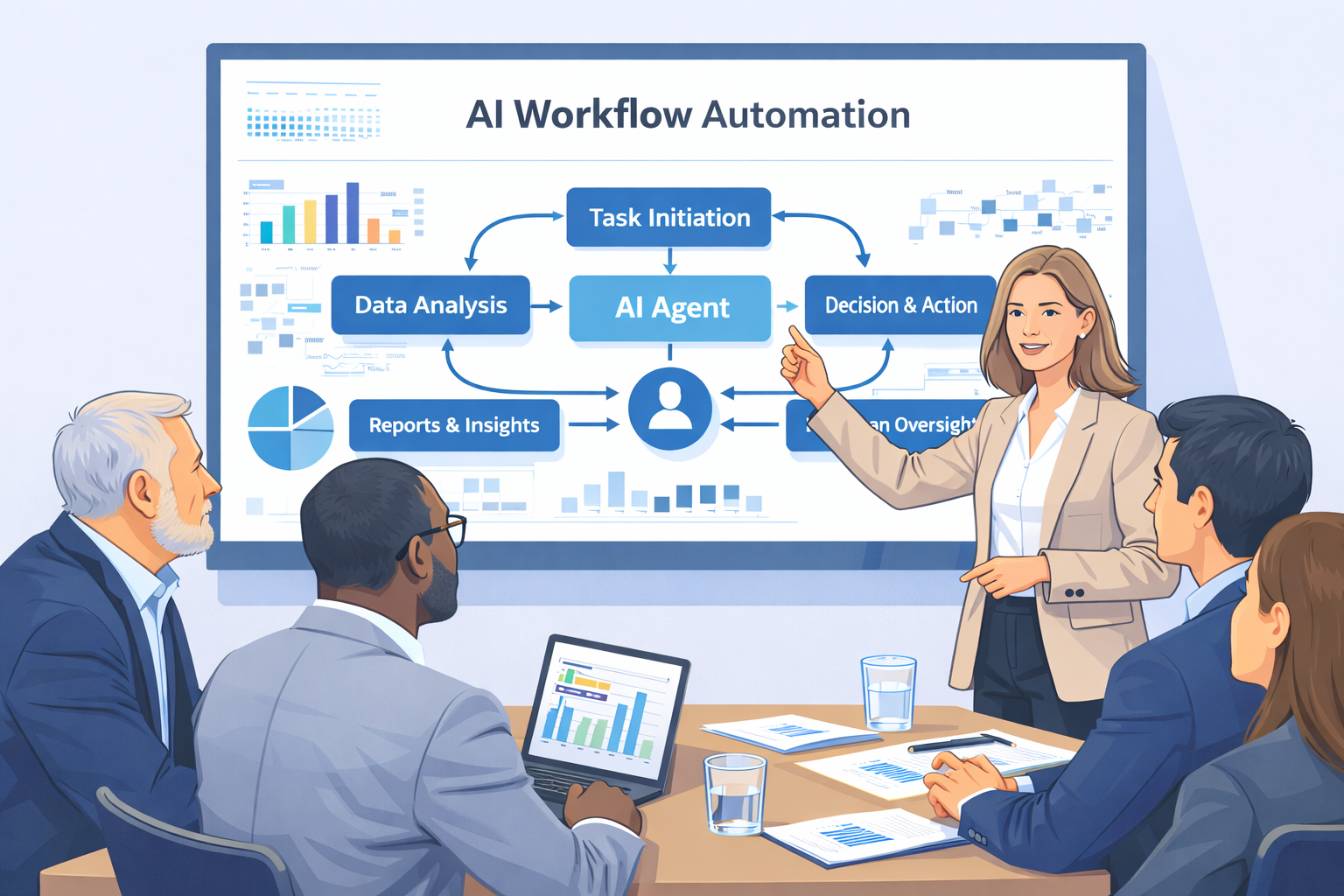
The framing that most organizations are missing is continuity. Agentic AI is not a separate initiative that replaces what came before. It is the next layer of capability built on top of the foundation that earlier adoption either created or failed to create.
The question is not whether to prepare for agents. They are coming regardless, through the same vendors whose tools are already in your environment. The question is whether the organizational capability to absorb and govern them is in place — or whether the next wave of AI adoption will repeat the same pattern of deployment without foundation, impact without measurement, and change without structure.
The organizations that treat their current AI adoption as preparation for what comes next are the ones that will actually extract the compounding value that AI promises. The others will keep buying licenses and waiting for the technology to do the work.
Mendo helps organizations build the adoption foundations and governance structures that make the transition from AI assistance to agentic capability a managed evolution, not a disruption.